
01
Film
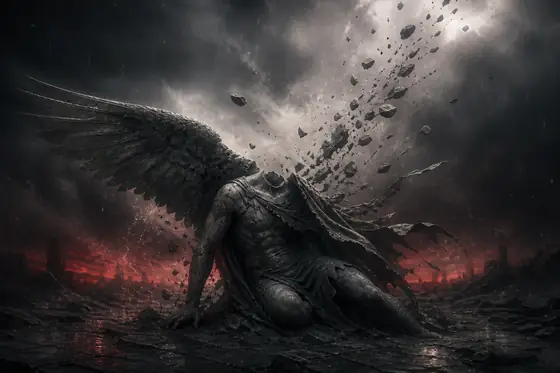
Roy Batty
Blade Runner · 1982
The antagonist who is right about everything, whose final act is mercy toward the man hunting him. No villain ending reframes a film more completely.
Threat index 81
A tragic villain is not one with a sad backstory attached as decoration. It is a character whose fall is structurally inevitable given who they were and what happened to them, and whose story would still be a tragedy if they had never hurt anyone. The order here reflects how completely the character's downfall is earned by the narrative rather than how sympathetic they are on paper.
How this list was scored. Scored on inevitability of the fall (35%), whether the story earns the sympathy rather than asserting it (30%), the moment of self-awareness if any (20%) and audience response (15%).
Media mix: Film (5), TV (3), Video games (2), Comics (2), Anime (2), Animation (1).
Blade Runner · 1982
The antagonist who is right about everything, whose final act is mercy toward the man hunting him. No villain ending reframes a film more completely.
Star Wars · 1977
The most famous redemption in popular fiction, and the reason the mask works: there is a person underneath who chose wrong and knows it.
Warcraft III · 2002
You perform every step of his fall yourself. Each terrible decision has a defensible reason at the moment you make it.
A survivor who watched one civilization decide a group of people were disposable and refuses to wait for the next attempt. The books have never told him he is simply wrong.
The man who was going to fix the city legally, reduced to outsourcing every decision to a coin. It is the cleanest tragedy in superhero comics.
A prodigy who was raised as an instrument and had no self left when the fear stopped working. Her collapse is the most upsetting scene in the series.
A war hero who read a file about his own origin and could not survive the answer. The villain is created in a single afternoon in a library.
The tragedy is that the excuse was never the reason, and the show waits five seasons to let him admit it out loud.
What makes it a tragedy is not what he becomes but how genuinely good the earlier version was, and how deliberately he gave it up.
A gifted student handed unlimited power at eighteen. The story is careful to show that he was not a monster before he found the notebook.
He is not in control of himself, and the film's final scene makes clear that the person who committed the murders is the one who has already lost.
A man losing to alcohol, failure and isolation, with a building actively helping. The novel is a tragedy; the film is a horror movie about one.
Never had a childhood, never had a name until adulthood, and was manufactured as a product. It does not excuse anything, and the show knows that.
Every part of the empire is a means to an end he has been carrying for twenty years, and it is the only thing that ever makes him careless.
The least discussed tragedy in horror. He is a non-verbal, terrified man doing what his family tells him, and the film is entirely clear about that.
Every ranking on this site can be re-sorted by any single attribute. Open this list in the hub and rebuild it by power, intellect, fear or cultural impact, then save your own top picks.